Five Questions for Learning:
To support students to take ownership of their learning, teaching in classes are referring to the five questions for learning:
What are you learning? Why? How are you going with your learning? How do you know? What do you need to do to improve? Where can you get help? Leaders in the school use these questions when they are in classrooms on Learning Walks throughs. This is an opportunity for students to share their learning and for the school to Know the Learner and then make plans to support the students in their next steps.
Have a great couple of weeks and remember to follow the Communication Flowchart if you have any questions relating to your student.
NAPLAN
Our students are amid assessment, and it is important that your student attends school to complete their assessment and meet deadlines. Yr 7 and 9 students will be completing NAPLAN practice next week and it is to ensure the delivery of NAPLAN over Week 7 and 8 runs smoothly. We wish our Yr 7 and 9 students all the best as they tackle NAPLAN from Wednesday 11th March and remember there will be a breakfast provided to the students on Day 1 and Day 3 of NAPLAN Monday 16th March, served at 8.30am.
Senior Students driving
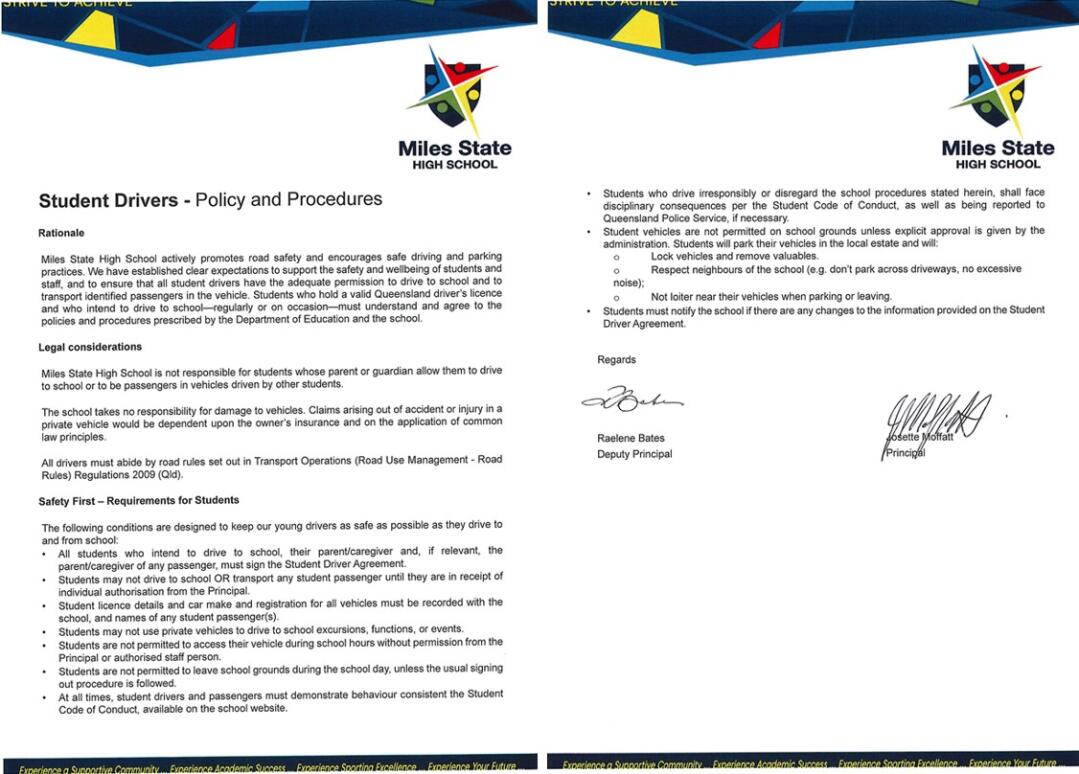
Each year our senior students are achieving their Provisional licence to drive a vehicle. It is a time to celebrate but also a time to be cautious especially when other students are travelling with them. Our rules with bringing your vehicle to school and driving has not changed, and a form requiring your parent’s permission is required annually whilst at school. This form can be collected from our main admin office. Until this form has been completed, students should not be driving their vehicle to school.
If you are a passenger, you require written permission from your parent to travel in someone else’s vehicle. This correspondence must be given to the main admin office, and we must also receive from the driver’s parent confirmation that they are happy for their child to be driving the other student/s.
If this process is not followed students will be informed that they will not be able to bring their vehicle to school and will be required to find another source of transport.
Student riding bikes
Not only is riding to school healthy for kids, but it is also fun! If your child is in primary school, you can ride with them until they are confident. Once they have the skills and feel safe on their bike, try to find a friend from their school they can ride with.
Parents can teach children riding to school:
- the safest route to school using bike paths, footpaths (for primary kids) or suburban streets
- the road rules and what road signals and signs mean
- what to do in an emergency
- bike hand signals to let others know where they are going
- to ride wearing correctly fitted helmets
- to prepare for the unexpected, be tolerant towards other mistakes and courteous to others using the road.
Queensland Government states when you ride a bicycle, you must wear an approved bicycle helmet. You must securely fit and fasten it. An approved bicycle helmet means a helmet that is certified. Wearing a properly fitted bicycle helmet remains compulsory.
Scooters
Riding a non-motorised scooter is a quick and fun way for kids to get to school! For parents it’s easy to walk alongside a child on a scooter. Riders are not legally required to wear a helmet when using human-powered wheeled recreational devices. However, a helmet is required if the scooter has an electric motor.
On top of following the general road rules a there are a few different rules in place for riders that ensure a safer ride:
Non motorised scooters
- keep to the far left-hand side of the road and to the left of a footpath
- give way to foot pedestrians on a footpath and bike riders on a bike path or lane
- don’t travel on a road with a speed limit greater than 50km/hr, with a median strip, centre line or 1 way road with more than 1 marked lane.
Local governments often have local laws prohibiting the use of wheeled recreational devices and wheeled toys on busy roads and footpaths.
Contact your local council for more information on local laws in your area.
Raelene Bates